The Complete Guide to Domain Blocking Programmes | Lexsynergy
The Complete Guide to Domain Blocking Programmes
Comparing the key domain blocking programmes businesses use to protect their brands online. Covering: GlobalBlock, DPML, AdultBlock and NameBlock.
Published: 1 Apr 2026
Domain blocking is an online brand protection service that prevents third parties from registering domain names matching a trade mark or brand across multiple domain extensions.
The Domain Name System (DNS) has expanded dramatically over the past decade. Today there are more than a thousand domain extensions available globally, ranging from widely recognised generic Top-Level Domains (TLDs) such as .com and .net to hundreds of industry specific TLDs including .bank, .lawyer and .kids and over 300 geographic Country-Code Top-Level Domains (ccTLDs) from .de to .cn.
While this expansion has created new opportunities online, it has also increased the risk of brand impersonation, cybersquatting and domain abuse. For businesses managing valuable brands, protecting trade marks across such a large and growing online namespace can be challenging.
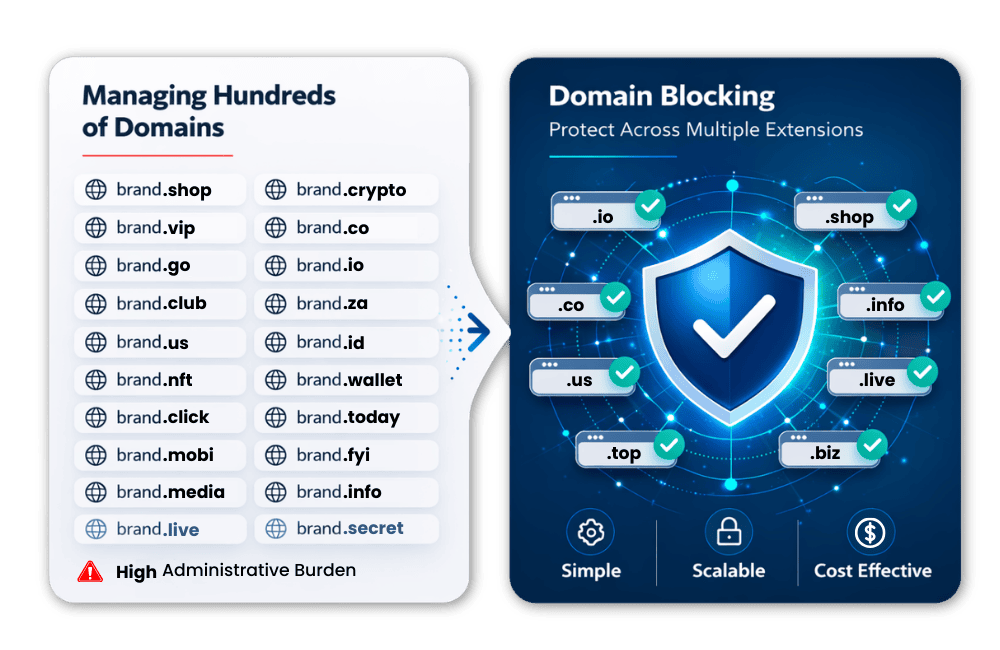
Traditionally, companies attempted to address this by registering defensive domain names across a multitude of extensions. However, as the number of domain extensions has expanded, domain blocking services have emerged as a more scalable way to prevent unwanted registrations.
To address this problem, domain registries introduced domain blocking programmes, made available to businesses through domain registrar partners such as Lexsynergy. These services allow brand owners to prevent the registration of domain names matching their brand across multiple domain extensions simultaneously.
This guide explains how domain blocking works, how it compares to a defensive domain registration approach and the key domain blocking programmes that are available to businesses: GlobalBlock, DPML, AdultBlock and NameBlock.
What is Domain Blocking?
Domain blocking prevents unauthorised third parties from registering domains matching a specific brand, trade mark or specified name across multiple domain extensions.
Instead of registering individual domains, a block reserves a selected string, such as ‘bestdomainregistrar’ across participating domain extensions, ensuring it cannot be registered by someone else.
For example, if bestdomainregistrar is blocked, the domains listed below would be blocked from registrations:
bestdomainregistrar.business
bestdomainregistrar.company
bestdomainregistrar.email
bestdomainregistrar.xxx
Unlike a traditional domain registration, blocked domains are non-functional, meaning they cannot be used for a website or email address and there is no recognised ownership. Instead, they are simply reserved within the domain blocking system and made unavailable for future registrations.
Domain blocking therefore acts as a preventative brand protection measure, helping businesses reduce the risk of cybersquatting and online impersonation.
How Domain Blocking Works
Domain blocking services operate at the registry level, meaning the protection is applied directly within the systems that manage domain extensions. Rather than registering a domain name and holding it, the registry effectively removes that name from public availability so that no one else can register it.
A useful way to think about domain blocking is to imagine a product that is never released for sale, rather than a product that is purchased and owned by someone. When a domain is blocked, it is simply not available for registration at all, preventing anyone from securing it in the first place.
The process typically works as follows:
1. Rights to the name are established
The organisation seeking protection must demonstrate legitimate rights to the name they wish to block. This is usually done through a registered trade mark, although some programmes may also accept verified brand rights or recognised public identities.
2. Trade mark validation may be required
For programmes that rely on the Trademark Clearinghouse (TMCH), the trade mark must first be validated within the TMCH database. As an accredited Trademark Clearinghouse agent, Lexsynergy can manage this process on behalf of clients, preparing the documentation and submitting the application to ensure it meets the validation requirements.
3. Application is submitted to the blocking programme
Once eligibility is confirmed, Lexsynergy submits the domain block request to the relevant blocking provider. As an accredited provider of these services, Lexsynergy acts as the conduit between brand owners and the registry or programme operator. It is not possible to go direct.
4. The domain label is added to the block list
After approval, the registry adds the brand name to its blocking list. From that point onward, domains matching the blocked label cannot be registered by third parties across the participating domain extensions.
5. Variations can also be blocked
Many domain blocking programmes also allow variations of a brand name to be protected. These can include typographical errors, visually similar characters or Unicode lookalikes that are commonly used in phishing and impersonation attacks.
Benefits of Domain Blocking
Domain blockingprovides a scalable way for businesses to protect their brands across the expanding domain name ecosystem.
Instead of registering and managing hundreds of individual domain names, businesses can prevent unauthorised registrations across multiple domain extensions through a single service. This helps reduce the risk of cybersquatting, phishing and brand impersonation while simplifying domain portfolio management.
As new domain extensions continue to launch, domain blocking allows organisations to maintain broad online brand protection without significantly increasing administrative overhead.
Who Is Eligible for Domain Blocking?
Domain blocking services are designed to protect legitimate brand rights, so applicants must typically demonstrate ownership or control of the name being blocked.
Eligibility requirements vary by programme but generally fall into several categories:
Trademark Clearinghouse (TMCH)
Some domain blocking programmes require trade marks to be validated through the Trademark Clearinghouse (TMCH). The TMCH is a centralised verification system created as part of ICANN’s new gTLD programme to confirm that a trade mark is legitimately registered, that the rights holder is correctly identified and that the mark is being actively used. Once a trade mark has been successfully validated within the TMCH, it can be used to access a range of domain and brand protection services, including domain blocking programmes.
Submitting a trade mark to the TMCH requires supporting documentation and evidence of use. Lexsynergy is an accredited Trademark Clearinghouse agent, meaning our specialists can manage the submission process on your behalf and ensure that applications are completed accurately and efficiently. By guiding organisations through the TMCH verification process, Lexsynergy helps simplify access to domain blocking services and other trade mark protection mechanisms.
Verified Rights Holder
Some domain blocking programmes allow organisations or individuals to qualify as verified rights holders. In these cases, eligibility may extend beyond registered trade mark owners to include companies that can demonstrate commercial use of a brand name, well known organisations with established rights to a name, and public figures or institutions whose names have recognised public or commercial significance. This broader eligibility framework allows domain blocking services to protect legitimate brand or identity rights even where a formal trade mark registration may not exist.
Brand Verification
Some domain blocking services conduct their own verification process rather than relying solely on external trade mark validation systems. In these cases, applicants must demonstrate that they have legitimate rights to the name they wish to protect.
Comparison of Domain Blocking Programmes
Several key domain blocking services are available, each operated by different registries or registry groups. They differ in the number of domain extensions covered, variant protection capabilities, eligibility requirements and registry participation.
Domain Blocking Programmes Overview
Domain Blocking Programme
Operator / Registry
Launch Year
Coverage Model
TLD Coverage
Variant Protection Available
Eligibility Requirement
GlobalBlock
Brand Safety Alliance
2024
Multi-registry unified block list
600+
Yes (GlobalBlock+)
Verified rights holder
DPML
GlobalBlock and GlobalBlock+ Explained
GlobalBlock is currently the most extensive domain blocking service available, protecting brand names across hundreds of domain extensions operated by multiple registries. Developed by the Brand Safety Alliance, GlobalBlock was created to provide a unified and scalable approach to Domain Blocking.
Today, GlobalBlock protects brands across more than 600 domain extensions, including generic top-level domains (gTLDs), country-code domains (ccTLDs), as well as Web3, blockchain-based domain extensions.
GlobalBlock is available to verified rights holders including trade mark owners, brand owners and organisations with recognised rights to a name.
GlobalBlock is available in two product tiers:
GlobalBlock provides exact match domain blocking across all participating domain extensions.
GlobalBlock+ provides enhanced protection with homoglyph variant coverage.
What Makes GlobalBlock Different?
One of the key differentiators of GlobalBlock is that it is a dynamic service rather than a static block list. As additional registries join the programme, new domain extensions are automatically added to the protection at no additional cost until renewal.
GlobalBlock also includes a unique feature called Priority AutoCatch for a majority of the included extensions. If a previously registered domain matching a blocked brand expires and becomes available, the system automatically blocks it before it can be re-registered by a third party. Thousands of domains have already been captured for rights holders using this mechanism, preventing potential abuse before it can occur.
Expanding Global Coverage
GlobalBlock coverage is expected to increase significantly in the coming years, with two of the world’s largest country-code domains joining the programme soon, .cn (China), including more than 40 sub-zones and .de (Germany). These domains represent major global internet markets and their inclusion significantly increases the scope of domain blocking protection.
Another important factor is the next ICANN round of new gTLDs, expected to introduce hundreds of additional domain extensions in 2026 and 2027. GlobalBlock is already working with potential registry applicants to ensure these future extensions can be included in the programme where possible. GlobalBlock’s approach helps ensure domain blocking protection remains effective as the domain ecosystem continues to expand.
DPML and DPML+ Explained
The Domains Protected Marks List (DPML) was the first large scale domain blocking programme introduced following the expansion of new gTLDs between 2013 and 2016.
Operated by Identity Digital, DPML allows trade mark owners to prevent the registration of domain names matching their brand across the registry’s portfolio of domain extensions. DPML protects domains across hundreds of TLDs operated by Identity Digital, making it one of the largest registry specific blocking services available.
DPML is available to organisations with a trade mark validated through the Trademark Clearinghouse (TMCH), which serves as the eligibility requirement for participating rights holders.
DPML is offered in two product tiers.
DPML - Provides protection against exact match domain registrations
DPML+ - Extends protection to include three additional domain variants, such as typographical variations, homograph domains and visually similar characters.
The Identity Digital portfolio includes a wide range of commercially focused domain extensions. A few are listed below:
All DPML extensions are also included in GlobalBlock.
AdultBlock and AdultBlock+ Explained
AdultBlock is a domain blocking service designed specifically for the adult domain namespace. It helps brands prevent their names from being registered across high risk domain extensions commonly associated with adult content.
The service blocks domain registrations across the following TLDs operated by ICM Registry: .xxx,.porn, .sex and .adult.
For many organisations, preventing their brand from appearing within adult themed domain extensions is an important part of protecting brand reputation and avoiding unwanted brand associations.
AdultBlock is available to verified rights holders including trade mark owners, brand owners and organisations with recognised rights to a name.
AdultBlock is available in two product tiers:
AdultBlock provides protection for exact-match domain registrations.
AdultBlock+ extends this protection by blocking common domain variants, including typographical variations, homoglyph characters and visually similar brand variants.
By preventing registrations within the adult domain space, AdultBlock helps organisations reduce the risk of brand misuse and reputational harm within this specific segment of the domain ecosystem.
The four AdultBlock extensions are also included in GlobalBlock.
NameBlock Services Explained
NameBlock provides a suite of domain blocking services designed to prevent malicious registrations across both traditional domain extensions and emerging digital namespaces.4
Unlike registry operated domain blocking programmes which apply protection across predefined portfolios of domain extensions, NameBlock allows organisations to build a modular blocking strategy by selecting the specific extensions they want to protect their brand in.
This flexibility allows businesses to focus protection and expenditure on the extensions most relevant to their brand, rather than a blanket approach.
To qualify for NameBlock services, applicants must demonstrate legitimate rights to the brand or name they wish to protect. This is done through NameBlock’s brand verification process, which may include reviewing trade mark registrations, proof of commercial use, or other evidence of brand ownership.
NameBlock currently offers three primary services:
BrandLock – Exact match blocking across selected domain extensions
AbuseShield – Variant blocking across selected domain extensions
BrandLock for Freename - Web3 Domain Blocking – Blocking across blockchain based naming systems
Together, these services allow organisations to implement a more tailored approach to preventing domain abuse.
BrandLock
BrandLockprovides exact match domain blocking, preventing domains that exactly match a protected brand name from being registered across selected domain extensions.
A key differentiator of BrandLock isthat organisations can choose which domain extensions they want to block, rather than applying protection across a predefined registry portfolio. This allows businesses to focus protection on extensions that are most relevant to their brand or where abuse is most likely to occur.
As the service is modular, organisations can create a customised blocking portfolio based on their risk profile, industry or geographic markets.
AbuseShield
AbuseShield focuses on preventing malicious domain variants that are commonly used in phishing, fraud and impersonation attacks.
Using automated detection methods, AbuseShield can identify and block domain registrations that closely resemble a protected brand, including typographical variations, homoglyph characters (visually similar characters) and suspicious prefixes or suffixes frequently used in phishing campaigns.
By proactively blocking high risk variations, AbuseShield reduces the opportunities for attackers to register domains designed to imitate legitimate brands.
BrandLock for Freename - Web3 Domain Blocking
NameBlock in partnership with Freename, also offers blocking protection within Web3 domain ecosystems.
Web3 refers to a new generation of internet infrastructure built on blockchain technology and decentralised networks. In these systems, domains can be minted on blockchains rather than registered through traditional domain registries.
However, as Web3 naming systems generally operate outside the traditional DNS framework, they often lack established trade mark protection mechanisms.
NameBlock’s Web3 blocking service allows businesses to prevent the minting of domains matching their brand across participating Web3 namespaces, helping protect brands in thousands of emerging Web3 extensions.
Conclusion
As the domain name ecosystem continues to expand, domain blocking has become an important tool for protecting trade marks online.
While defensive domain registrations remain important for core brands that businesses actively use, registering large defensive portfolios across hundreds of extensions is often expensive and difficult to manage.
Domain blocking programmes provide a scalable alternative, allowing brand owners to prevent registrations across multiple domain extensions simultaneously.
Among the available services, GlobalBlock currently offers the broadest cross registry coverage, while other programmes such as DPML and AdultBlock provide targeted protection within specific registry ecosystems.
For many organisations, the most effective strategy is a layered approach that combines defensive registrations for key domains paired with domain blocking services to prevent wider abuse.
As every brand’s risk profile and domain portfolio is different, determining the right online brand protection strategy requires a careful assessment of the domains that matter most and the namespaces where abuse is most likely to occur.
Lexsynergy specialises in helping organisations develop effective online brand protection strategies. Our experts can conduct an initial audit of your domain portfolio to help identify risks and determine the most effective combination of defensive registrations, domain blocking services and monitoring solutions.
If you would like to understand how your brand could benefit from domain blocking, get in touch with the Lexsynergy team to arrange an initial domain audit.
FAQs
What is domain blocking?
Domain blocking prevents third parties from registering domain names that match a brand or trade mark across multiple domain extensions. The domains are reserved at the registry level so they cannot be registered by others.
Is domain blocking cheaper than defensive registrations?
In many cases, yes. Domain blocking protects a brand across hundreds of domain extensions with a single service, whereas defensive registrations require registering and renewing each domain individually.
Do I need a trade mark to block a domain?
Some domain blocking services require a verified trade mark, often validated through the Trademark Clearinghouse. While other programmes also accept alternative proof of brand rights.
Can I register a domain that is blocked?
The owner of a domain block can usually unblock a specific domain in order to register and use it.
Does a domain block cover already registered domains?
Domain blocking only prevents future registrations. If a domain is already registered by someone else, the block will not automatically remove it. However, GlobalBlock includes a feature called Priority AutoCatch, which automatically blocks matching domains if they expire and become available again.
Does domain blocking stop cybersquatting?
Domain blocking prevents many forms of cybersquatting within participating domain extensions but does not prevent abuse in extensions outside the programme.
Which domain blocking programme covers the most TLDs?
GlobalBlock currently covers the largest number of domain extensions, protecting brand names across more than 600 TLDs operated by multiple registries.
What is a typographical variation?
A typographical variation is a domain name that contains a small spelling mistake or alteration of a legitimate brand name. These variations are often used in cybersquatting or phishing attacks to trick users into visiting a fraudulent website.
For example, a typographical variation of brand.com might include:
Discover how to identify websites and domains that copy or target your brand using Lexsynergy’s Domain Audit and Domain Watch, enabling early detection, evidence capture and enforcement against phishing, fraud and infringements.
If a business later wishes to use a blocked domain name, the block holder can typically temporarily unblock the domain and register it themselves. It is important to note that domain blocks only prevent future registrations. If a domain matching a brand name has already been registered before the block is applied, the blocking service will not automatically remove it.
However, this does not mean the domain cannot be addressed. If an existing domain infringes on a brand’s trade mark rights, Lexsynergy provides a full range ofonline brand protection services to help businesses recover or remove abusive domains. Our specialists have a 100% success rate in domain compalints and can assist with dispute procedures, takedowns and enforcement strategies to address domains that have already been registered.
This may involve providing evidence such as proof of trade mark ownership, documentation showing commercial use of the brand, or confirmation that the applicant represents the brand owner or organisation associated with the name.
In some cases, individuals such as celebrities, public figures or well known personalities may also be able to obtain protection for their personal name. Where a name has established public recognition or commercial value, domain blocking services may allow the individual or their authorised representative to block domains matching that name in order to prevent impersonation or misuse.
These verification requirements help ensure that domain blocking programmes are used to protect legitimate brand or identity rights rather than to prevent unrelated parties from registering domain names legitimately.
Identity Digital
2013
Registry portfolio block
300+
Yes (DPML+)
Trademark Clearinghouse
AdultBlock
ICM Registry
2019
Adult namespace registry block
4
Yes (AdultBlock+)
Verified rights holder
BrandLock
NameBlock
2024
Customisable extension selection
40+
No
Brand verification
AbuseShield
NameBlock
2024
Customisable extension selection
40+
Yes
Brand verification
BrandLock for Freename
NameBlock
2024
Web3 namespace block
1000's
Variant dependent
Brand verification
Feature Comparison of Domain Blocking Programmes
Feature
GlobalBlock
GlobalBlock+
DPML
DPML+
AdultBlock
AdultBlock+
BrandLock
AbuseShield
BrandLock for Freename
Exact match domain blocking
Yes
Yes
Yes
Yes
Yes
Yes
Yes
No
Yes
Typographical variant protection
No
No
No
Yes
No
Yes
No
Yes
Variant dependent
Homoglyph protection
No
Yes
No
Yes
No
Yes
No
Yes
Variant dependent
Unicode variant blocking
No
Yes
No
Yes
No
Yes
No
Yes
Variant dependent
Blocks domains across multiple registries
Yes
Yes
No
No
No
No
Extension dependent
Extension dependent
Web3 namespaces
Web3 namespace protection
Yes
Yes
No
No
No
No
No
No
Yes
Premium Domains Covered
Limited
Limited
Limited
Yes
No
No
Yes
Yes
N/A
brandd.com
brand-login.com
Attackers rely on common typing errors made by users to redirect traffic to malicious websites.
What is a homoglyph attack?
A homoglyph attack occurs when attackers register domain names using characters that look visually similar to legitimate letters or numbers in order to impersonate a brand or website.
For example, attackers may replace the letter “o” with the number “0”, or the letter “l” with the number “1”, creating domains that appear almost identical to legitimate ones.
Because these characters look nearly identical, users may not notice the difference when viewing the domain name.
These attacks become even more sophisticated with the use of Internationalised Domain Names (IDNs), which allow domain names to include characters from non-Latin scripts such as Cyrillic, Greek, or others. Many of these characters are visually indistinguishable from standard Latin letters.
For instance, the Cyrillic character “а” (Unicode U+0430) looks identical to the Latin “a”, and “е” (U+0435) can be mistaken for the Latin “e”. An attacker can register a domain using these characters to create a website that appears identical to a legitimate domain, while technically being completely different.
This technique, often referred to as an IDN homograph attack, makes it significantly harder for users, to detect fraudulent domains.
What is a Unicode variant?
A Unicode variant is a domain name that uses characters from different writing systems that visually resemble characters in the Latin alphabet.
Unicode allows domain names to contain characters from many languages, such as Cyrillic, Greek or Asian scripts. Attackers can exploit this by registering domains that look identical to a legitimate brand but use characters from another script.
For example, a Cyrillic character may visually resemble the Latin letter “a” or “e”, creating a deceptive domain name that appears legitimate.
Who should use domain blocking?
Domain blocking is commonly used by organisations that own registered trade marks or well known brand names. It is particularly useful for global brands, e-commerce companies, organisations that face a high risk of phishing or impersonation attacks.
What does domain blocking not protect against?
Domain blocking prevents new domain registrations within participating domain extensions. However, it does not remove domains that have already been registered, nor does it protect against abuse in domain extensions that are not part of the blocking programme.
Is domain blocking worth it?
For businesses with valuable brands, domain blocking can provide broad protection across hundreds of domain extensions without the cost and administrative overhead of registering defensive domains individually.
What is the difference between GlobalBlock and DPML?
GlobalBlock protects domain names across multiple participating registries and currently covers over 600 domain extensions. DPML protects domain names within the Identity Digital registry portfolio and requires a trade mark validated through the Trademark Clearinghouse (TMCH).
That tiny missing “m” has the potential to lead your customers to a completely unrelated site, a competitor, or a scam, all of which could have been avoided.